
Understanding the MOU
A plain-language guide to the agreement now guiding how Marblehead's approved override funds will be managed.
In Spring 2026, Marblehead voters approved a Proposition 2½ override: a permanent increase to the town's property tax limit. This was necessary to help close a $7.7 million budget gap projected for Fiscal Year 2027 (the year that starts July 1, 2026).
Before the vote, the three boards that oversee town and school spending (the Select Board, School Committee, and Finance Committee) signed a document called a Memorandum of Understanding (MOU).
It's a public promise about exactly how override money would be raised, split, spent, and reported on through 2029. Now that voters have approved the override, that MOU is in effect. This page breaks that document down.
What is an MOU?
An MOU isn't a law nor a contract. It's a written, public commitment: a pledge among the three boards about how they'd behave with the money if voters said yes. Think of it as the town saying, "if you approve this override, here's exactly what we're committing to do with it, and here's how we'll prove it to you."
The MOU itself acknowledges that future boards aren't legally bound by it. Elected officials can't make promises on behalf of people who haven't been elected yet. But the boards that signed it state they expect future boards to "honor and respect this public pledge." More on what that means in a bit.
A gradual increase in the levy
The override appeared on the ballot as a multi-tier choice. Voters were offered three funding levels to choose from, each covering FY27 through FY29. The largest (question 3) was approved, which permanently increased the town's allowed tax levy by $15,000,000.
The town committed to drawing (collecting and spending) only part of that capacity each year, ramping up over three years rather than all at once.
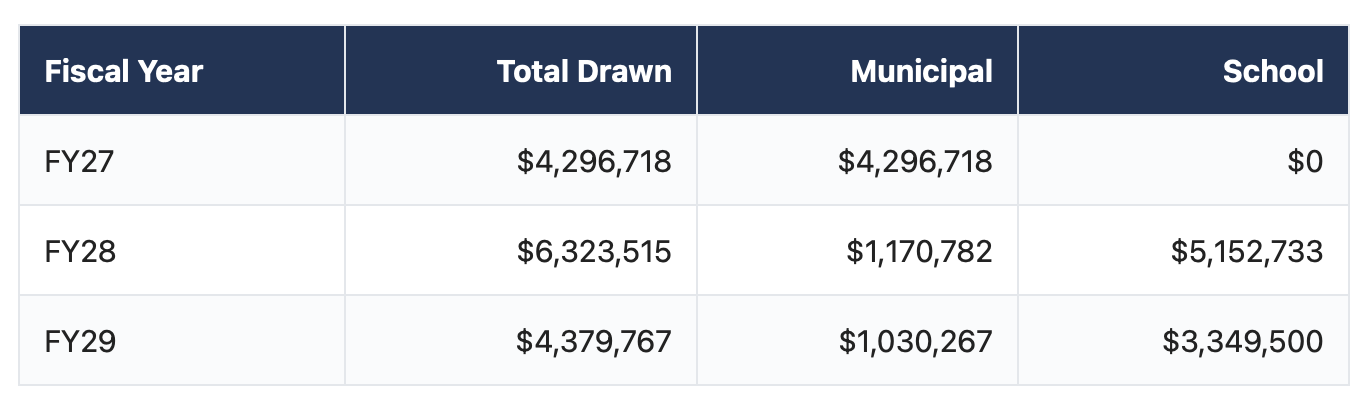
So, in FY27 the town will tax residents only enough to generate $4,296,718 in increased revenue. (All of that will go toward town needs - the schools don’t begin to realize support from override funds until year 2.)
The following year, FY28, the tax rate increases more, so as to raise the levy by another $6,323,515. And in the final year (FY29), another $4,379,767 is added… so that over the three years, the levy has been increased by a total of $15,000,000.
What if costs come in higher or lower than expected?
The override amounts are based on a three-year revenue forecast that makes specific assumptions. The MOU spells out what happens when reality differs from the forecast:
Free Cash (leftover funds from the prior year)
The plan assumes the town will rely $1 million less on Free Cash each year. If actual Free Cash comes in above forecast, the extra is split: $1M to unrestricted reserves, $1M to the Stabilization Fund, up to $2M to capital projects, and anything beyond $4M over forecast goes toward long-term liabilities like pensions and retiree health benefits. If Free Cash comes in below forecast, the override draw amounts above don't change — the town absorbs the shortfall elsewhere.
Health insurance costs
The forecast assumes active-employee health insurance grows 7% a year and retiree health insurance grows 5% a year. If actual costs come in higher, the override draw still doesn't change — the town has to find the difference elsewhere. If costs come in lower, the savings go into the Stabilization Fund rather than being spent elsewhere.
In short: the override draw ceilings in the tables above are hard caps. Bad budget news doesn't raise them; good budget news gets banked, not spent.
What other promises were made?
The MOU builds in regular public reporting starting in January 2027, plus a handful of other commitments to taxpayers beyond the override mechanics.
Public reporting
Town Administrator's State of the Town Address each January must report: how much override money was drawn and spent the prior year, how much levy capacity is still unused, what's budgeted from the override for the current year, and how much capacity is expected to remain unused by year's end.
The Superintendent of Schools must report annually to the School Committee on override funds drawn for school expenses, both past and budgeted.
Town Administrator and Superintendent must report at least quarterly to the chairs of all three boards on the town's overall fiscal position.
Other promises to taxpayers
Reducing the tax burden where possible:
promoting tax exemption, deferral, and Senior Tax Work-Off programs;
adopting a new Means-Tested Senior Citizen Property Tax Exemption for FY27;
pursuing new revenue sources;
finding cost-saving efficiencies across departments.
Strengthening the town's finances:
building the Stabilization Fund (the town's "rainy day" reserve) up to 5% of the operating budget and keeping it there;
continuing pension and retiree-benefit contributions at or above past levels.
A pressure valve for true emergencies: if something extraordinary happens — a major natural disaster, public health emergency, or serious economic crisis — all three boards can vote (by supermajority, in each) to reopen and review the MOU's terms.
What if the people who signed this are replaced?
It’s a relevant question! Since the MOU was signed, the Finance Committee Chair has stepped down, and the Town Administrator has announced his retirement, effective December 31, 2026: two of the people most responsible for carrying this agreement out.
WHAT THE MOU ITSELF SAYS: The agreement includes a footnote acknowledging this exact scenario: current boards and committees "cannot bind their successors," but the signers state they "expect that future boards and committees will honor and respect this public pledge." In other words, the MOU is not a legal contract that automatically transfers to whoever takes these roles next. It's a public commitment that depends on continuity of intent.
From here, the Select Board must hold the Town Administrator (whoever is in the role) to delivering the override reporting in every January State of the Town Address, and to providing the new chair of the Finance Committee the quarterly fiscal reports. The School Committee must require the Superintendent of Schools to report annually.
And voters need to hold all of these elected officials to their promises.
Additionally, we can reasonably expect — and should demand — that the incoming Town Administrator and the next Finance Committee Chair affirm their commitment to the MOU's terms before being put in place.