Looking for a deep dive on the budget situation?
Welcome to the Explainer
Understanding the general override, and what it could mean for our schools, services and community.
-
A general override is a permanent increase to the amount of property tax revenue a community can raise under Proposition 2½. It allows Marblehead to fund town services including schools, public safety, and infrastructure.
By law, the town’s tax revenue can only grow by 2.5 percent each year. That limit does not reflect the actual cost of running the town. Costs like health insurance, pensions, special education, and contractual salaries are rising faster than that.
That gap is what this override is designed to address.
-
Marblehead faces a growing gap between revenues and costs, putting our schools, services, and infrastructure at risk.
For years, costs have outpaced the limits of Proposition 2½, with little room for new revenue. Without action, difficult cuts are coming that will impact our quality of life.
-
Proposition 2½ is a Massachusetts state law that limits how much cities and towns can raise in property taxes each year.
Under this law:
A town’s total property tax revenue can only increase by up to 2.5% annually, regardless of how much costs rise
Communities can receive some additional revenue from new construction and development, but in built-out towns like Marblehead, this growth is limited
To raise more than 2.5%, a town must seek voter approval through a general override
Because property taxes are Marblehead’s primary source of revenue, Proposition 2½ creates a structural constraint: increasing costs for services including public safety, healthcare, infrastructure and public education outpace the town's ability to generate revenue.
A general override is the only way for residents to approve additional funding to maintain or improve services beyond what the 2.5% limit allows.
-
A few big reasons are that health insurance, pensions, and state-mandated special education costs are increasing faster than 2.5%.
Additionally, contractual salary increases happen every year. These are required costs, and they cannot be reduced without affecting services.
-
Yes.
-
Voters will have a choice about how to pay for curbside trash and recycling collection — either through the property tax levy or through a separate annual fee.
Because curbside trash and recycling collection is a fully sub-contracted service, the Select Board has decided to treat it separately from the main override question. Unlike the main budget and override, the trash question does not require Town Meeting approval — the cost is already included in the baseline budget alongside an offsetting fee. The Select Board will place it directly on the June ballot.
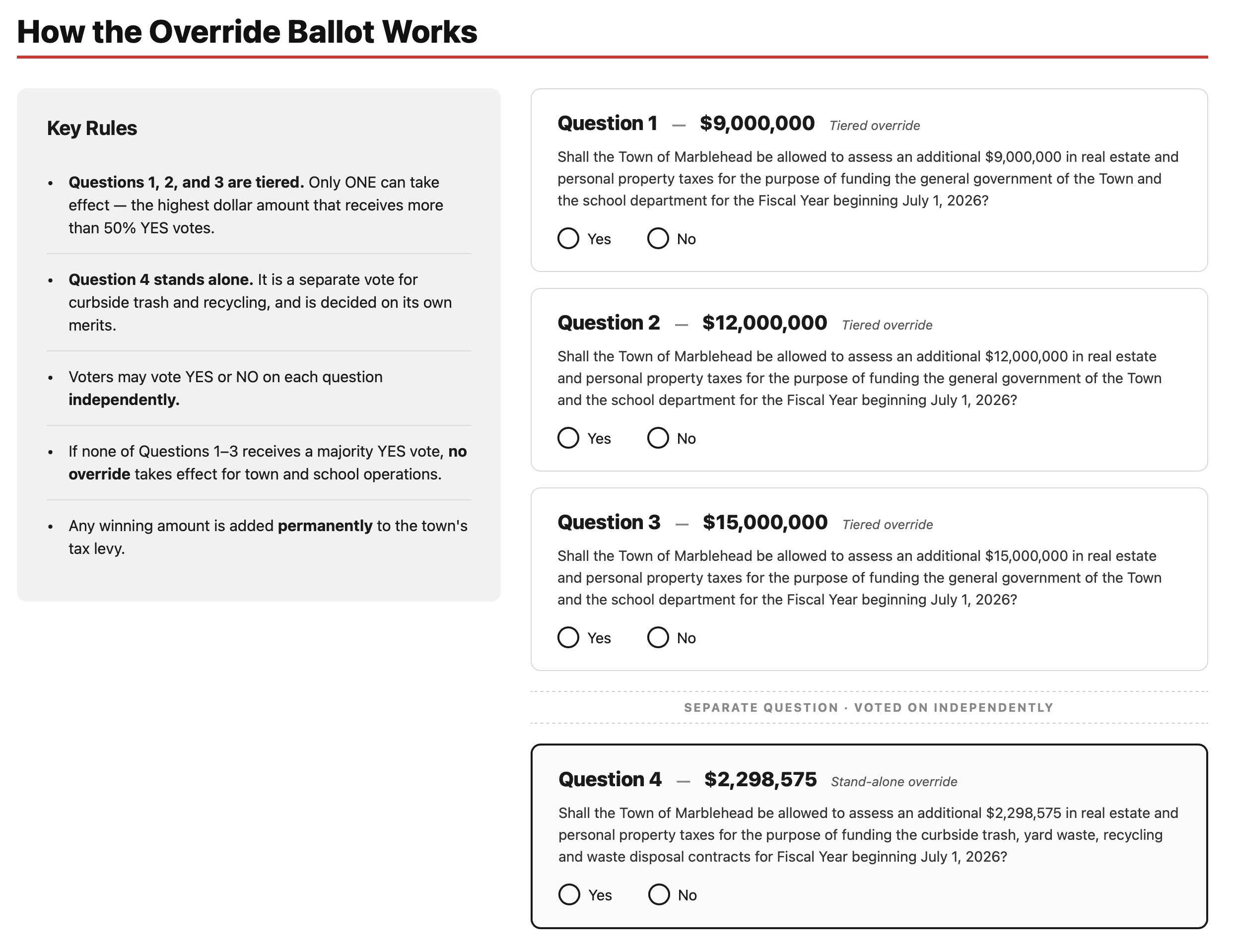
There will be four questions on the June 9 ballot:
Questions 1 & 2 & 3 relate to the three override tiers presented at Town Meeting which comprehensively cover all municipal services and the schools, excluding curbside trash collection.
Question 4 asks voters whether to cover the increased cost of curbside trash collection through the property tax levy. If it fails, the town will implement an annual residential trash collection fee of approximately $280 per household instead. Both options raise the same amount of money — the only difference is how it is billed and collected.
Why now?
Marblehead has been using cuts and one-time funds to close budget gaps for years. Those options are now largely exhausted. This is not a new problem, but it has reached a point where it can no longer be managed without new revenue.
-
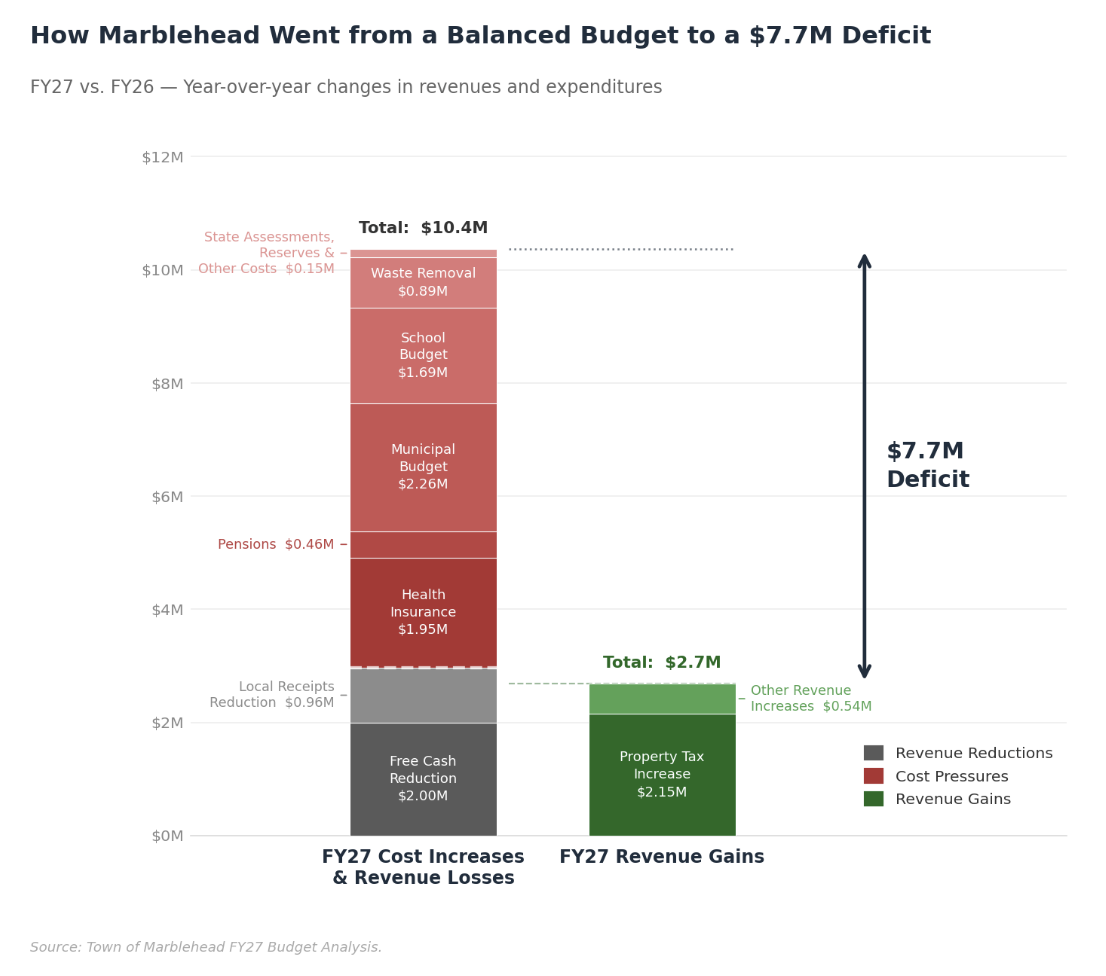
Like many Massachusetts communities, Marblehead faces a structural budget gap driven by rising costs and state-mandated limits on property tax growth under Proposition 2½.
To balance the FY27 budget, the town has identified approximately $7.7 million in cuts across both school and municipal services. If enacted, these cuts would lead to at least 35–40 job losses, reduced services, and deferred investment in critical infrastructure.
This challenge has been building for years, with the town relying on service cuts and one-time funds to close the gap in recent years. Marblehead has now reached a point where further reductions would meaningfully impact core services.
Under state law, increasing property tax revenue beyond 2.5% requires voter approval of a general override at Town Meeting and in a town-wide election.
For Marblehead believes a general override is now necessary to prevent further cuts and ensure a more sustainable financial footing going forward.
-
Yes and no.
There are three different types of overrides:General overrides permanently increase the tax levy more than the 2.5% allowed under Proposition 2½ to support ongoing town and school services.
Debt exclusion overrides allow municipalities to raise debt to fund specific capital projects like buildings and equipment. The override temporarily raises the tax level the above the Proposition 2 1/2 limits to pay down the debt; once the debt is paid off, the increased levy is removed.
Capital expenditure overrides are one-year tax overrides to pay for one-time purchases, etc. The one-time increase in the tax levy applies for one fiscal year.
Marblehead has consistently supported debt exclusion overrides for projects like the Brown School construction, Mary Alley building renovation, High School roof replacement, and major equipment purchases.
However, Marblehead has not passed a general override since 2005 to support day-to-day municipal and school operations.
For more than 20 years, the town has managed rising costs within the limits of Proposition 2½, largely through cuts and deferrals. That approach is no longer sustainable, and the current budget gap reflects that reality.
A general override would provide the ongoing funding needed to maintain services and restore financial stability. -
It is not uncommon to have your taxes increase more than 2.5% or, in some cases, even decrease.
Two things are potentially at play:
Changes in assessed values: Proposition 2 ½ limits the increase in the town’s overall tax levy, which is the total amount they can collect from property tax. Individual tax bills are based on the relative value of your property. If assessments increase in your neighborhood, you could see increases greater than 2.5%, but to ensure that the overall tax levy doesn’t increase more than 2.5%, taxes for other property owners in town may have increased less than 2.5% or even decreased.
Debt Exclusions Overrides: Overrides to support capital projects are incremental to the base tax levy. While the base tax levy may not increase more than 2.5% under Proposition 2 ½, the addition of successful debt exclusion overrides result in an increase greater than 2.5%. Those debt exclusion overrides are removed from your tax bill when they are paid off.
Either one of these scenarios can lead to changes in your tax bill that are greater than 2.5%.
-
HERE is a great op-ed from Melissa Clucas, School Committee member, explaining this dynamic in detail.
Marblehead is already a lean district:
Student-teacher ratio 11.4:1 matches state average
Per-pupil spending $21,972 is 4% below state average
MHS ranks top 20% in MA
Mandated Special Education requirements have grown significantly. Increasing numbers of high-needs students require additional staff regardless of overall enrollment levels. For example, students with autism have increased 34% and those with neurological or other health disabilities have increased 48% over the same period, even while overall enrollment is declining.
Out-of-district Special Education tuition growth is 12.64% for FY’27, on top of double-digit increases in prior years, which are costs the district cannot control as these services must be provided outside Marblehead if we do not have the capacity to deliver them.
Salaries are ~80% of the school budget. Contractual raises apply to every employee every year.
While school enrollment over the last decade has dropped 24%, teaching staff has also dropped nearly 15%. This enrollment decline is spread broadly across all 13 grades and five schools, so it’s difficult to reduce teaching staff until whole classrooms can be consolidated.
Marblehead has not passed a general override since 2005. The district has absorbed 20 years of structural underfunding.
What are the override options?
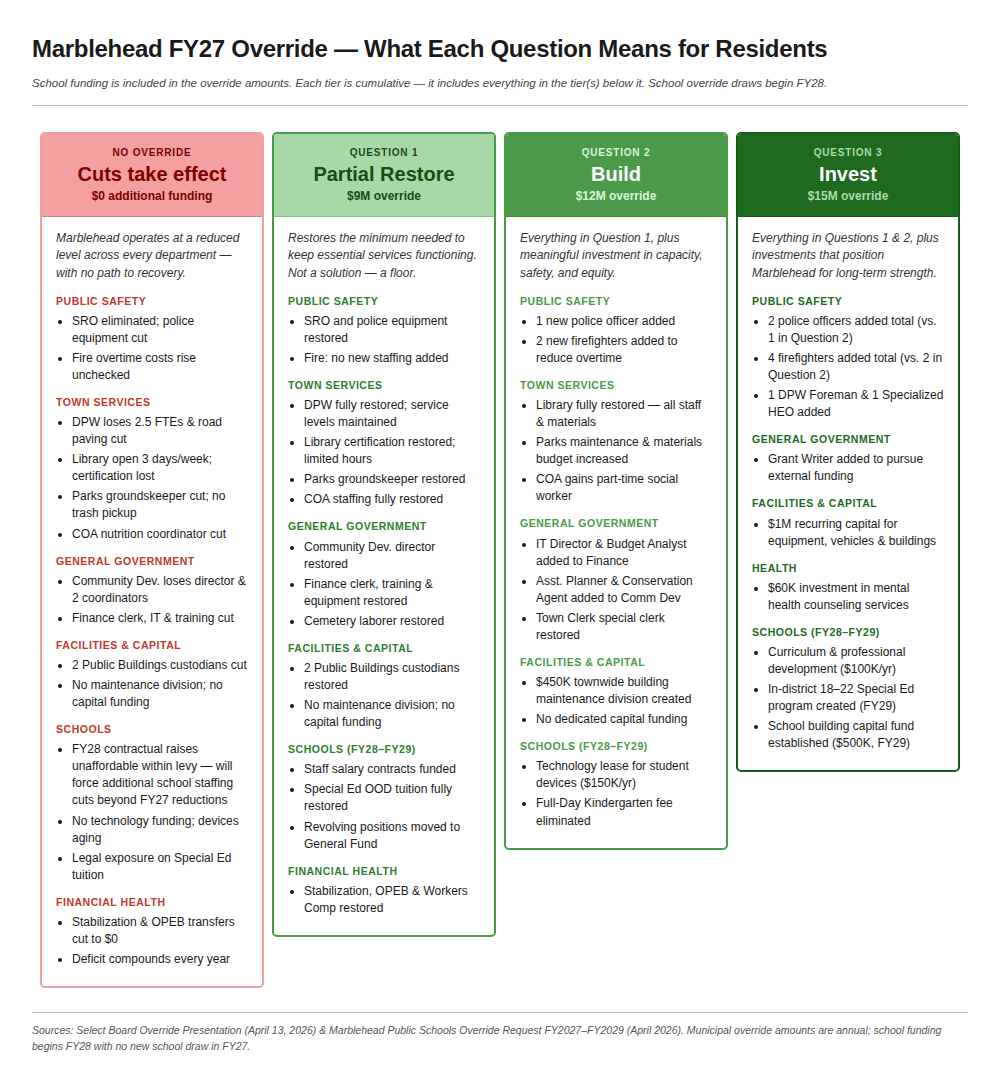
The override will use a tiered approach. The options were developed through the town’s budget process, based on identified needs across departments and in the schools.
Each option represents a different level of funding, and each one builds on the one below it:
Question 1 (partial restore) funds required costs, but town services and schools will still take a hit.
Question 2 (restore with minimal services) restores core services and adds some responsible measures, like a maintenance fund to ensure proper building upkeep.
Question 3 (fully restore and build) includes longer-term investments. Fixes the structural deficit.
All of the options are comprehensive and multi-year. Rather than focusing on short-term fixes or isolated cuts, this framework is designed to reflect the full scope of the town’s needs and the reality that costs will continue to grow over time.
Marblehead doesn't draw the full override levy immediately — spending needs phase in over three years as restored programs and positions come online. As a result, the tax impact grows each year, reaching its full annual level in FY2029.
What’s included in the override?
Questions 1-3 are all comprehensive and multi-year.
Rather than focusing on short-term fixes or isolated cuts, this framework is designed to reflect the full scope of the town’s needs and the reality that costs will continue to grow over time.
Each option builds on the last and is intended to show what different levels of funding mean for schools and services across the community.
A “memorandum of understanding” (MOU) has been approved by the Select Board, the School Committee, the Finance Committee and their respective administrative leaders, which would layer in extra oversight and accountability as to how the override funds would be managed. The MOU pledges that they will NOT seek an additional general override during the next three years if any of the override questions on the June 9 ballot are approved. The MOU also contains commitments to provide quarterly joint financial reviews of the town and school budgets, to re-build the Stabilization Fund (a true “rainy day” fund for real emergencies) to a full 5% of the overall operating budget, and to continue the fiscal accountability and transparency demonstrated throughout the FY27 budget deliberations.
-
— $3.2M total reduction to reach a balanced FY27 budget ($1.7M to level fund + $1.5M additional town-requested cut)
— 18.25 FTE positions
— $1.5M in Special Education out of district tuition covered by prepayment from FY26 surplus — cannot be repeated
— Revolving-funded positions shifted off the General Fund
— Supplies & professional development reduced
— Technology investments paused — devices and software aging
-
Special Ed OOD Costs Continue Rising: Out-of-district tuition and transportation are mandatory district obligations. Without override revenue, these costs crowd out everything else — and the district faces legal exposure if IEP obligations go unmet.
Staff Salary Increases Go Unmet: COLA and step raises are contractual. Without override revenue, they cannot be covered within the levy limit — straining staff retention and labor relations across the district.
Benefit Costs Outpace Revenue Every Year: Health insurance rose 11.17% this cycle. Pension contributions rose 8.6%. Revenue grows just 2.5%. This structural mismatch permanently widens without new funding.
Education Quality Declines: Superintendent Robidoux warned publicly: further cuts 'will 100% impact classrooms. It will 100% impact students.' Class sizes grow, interventions are cut, and the academic programs that define Marblehead's reputation erode.
Technology Falls Further Behind: Devices and software continue aging with no replacement plan. Marblehead students lose ground to neighboring districts making sustained technology investments.
The Problem Compounds Each Year: A 'no' vote does not freeze the school budget. It guarantees a larger structural gap in FY28 and FY29 — requiring a more difficult and painful vote in the near future.
How is this going to affect my taxes?
A Proposition 2½ override is a permanent increase to Marblehead's property tax levy. The cost phases in over three fiscal years. The impact on individual households depends on property value and the size of the override.
Here's what it looks like for an example home assessed at $1M:
NOTE: The tax calculator below shows you the incremental impacts that could happen following an override. It does not reflect all possible changes to your tax bill.
If any of these tax increases passed, how would Marblehead’s average tax bill compare to peer communities?
Marblehead's current average single family tax bill is ~$11,100 per year, ranking 16th of 17 peer communities.
If Marblehead passes Question 3 ($15M override) and the trash-specific override, the average single-family tax bill will increase to ~$13,600.
This would rank 11th of 16 peer communities and would still be below the average tax bill of $14,600. Even at the highest override option, our tax burden is competitive with peer communities.
This analysis is based on adding $17.3M (Question 3 + Trash) to the current tax levy at the FY26 assessed home values; it does not take into account that the override will phase in over three years during which peer communities will see their tax bills increase as well. When our full levy is drawn, Marblehead will likely be further down this list.
What is the process for passing an override?
First, town leaders define override options.
This is complete!
Then → Monday, MAY 4: Residents who attend Town Meeting vote on whether to place the override on the ballot - a simple YES or NO vote on each.
This is complete!
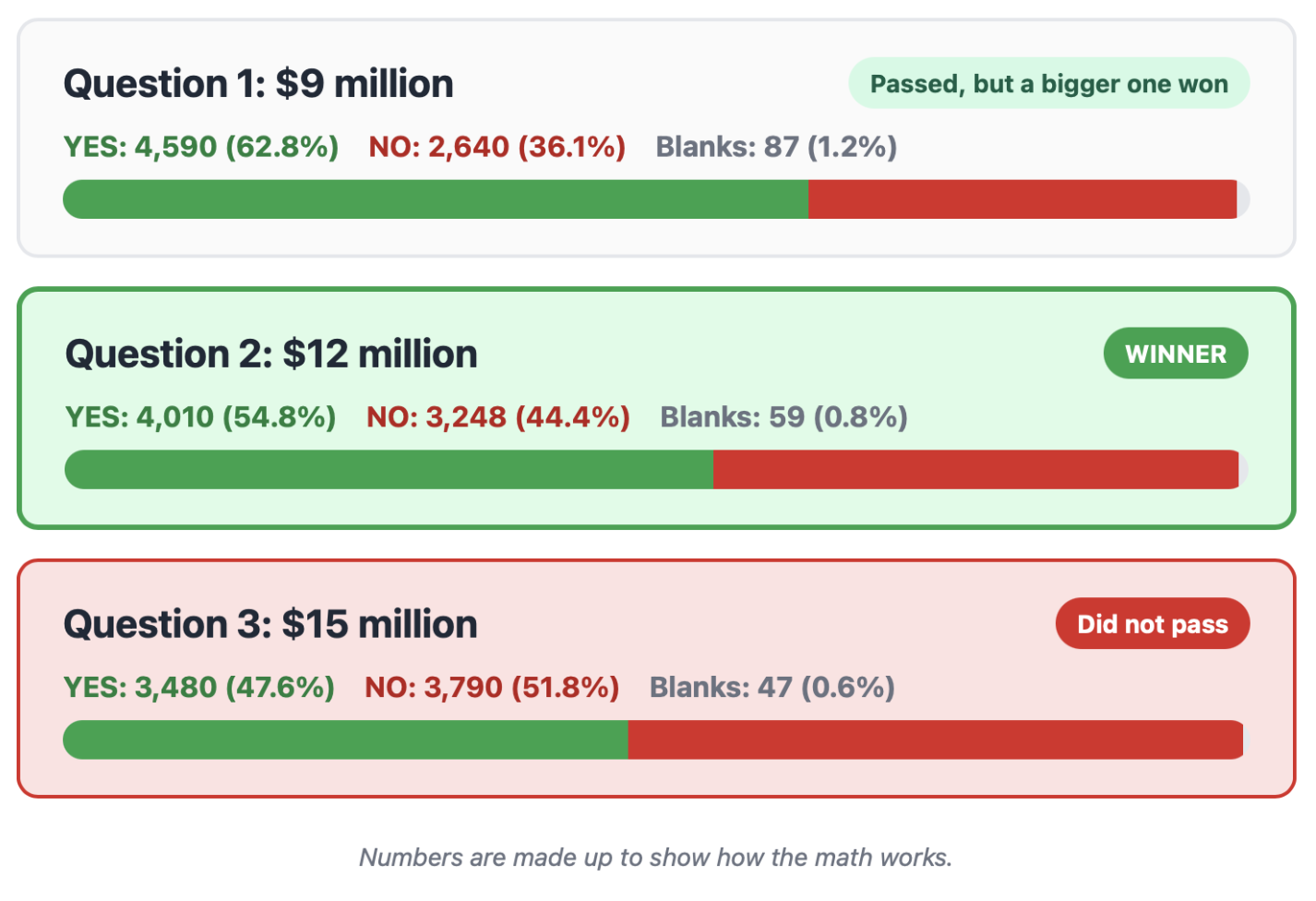
Finally → Tuesday, JUNE 9: At the ballot box, voters vote YES or NO on each override question independently. Each question requires a majority to pass. If more than one of questions 1-3 passes, the highest tier/question will prevail.
How will the June 9 ballot work?
4 override questions will be on THE BACK SIDE of the June 9 ballot.
Questions 1, 2 and 3 deal with the general operating override for the town and schools. Question 4 deals with town trash collection.
Residents will vote for or against each override question independently. So, on each question you’ll vote YES or NO.
Each question requires a majority to pass: more. YES votes than NO.
If more than one of questions 1-3 passes, the highest tier/question will prevail.
A hypothetical example is included below to illustrate how it would work.